



- The Challenge Of Context Switching In AI-First Marketing Teams
- Can Universal AI Memory Solve That For Content Teams?
- How AI Context Flow Helps Maintain Brand Voice Consistency
- Benefits of AI Context Flow For Multi-Brand Content Teams
- Functional Aspects: Technical Components Routing Right Context To Chat Agent
- Universal AI Memory Is The Best Solution For Content Teams
- Frequently Asked Questions
Universal AI Memory for Content Teams: Brand Voice Consistency Across Tools
By Hira • Jan 27, 2026
Marketing teams working across multiple brands face a persistent challenge: maintaining a consistent brand voice when switching between AI chat agents. Every time you move from ChatGPT to Claude to Gemini, you’re starting from position zero.
The AI chat agent does not even remember your brand guidelines, tone preferences, or the client brief you carefully crafted after having an hour-long chat with your client. These chat agents’ memory limitations and constant context switches force teams to re-explain everything, leading to inconsistent output and mismatched brand voice.
The problem intensifies for agencies managing multi-brand campaigns. Content creators spend hours re-inputting brand voice parameters, style guides, and campaign objectives with each new conversation. This repetitive briefing process not only slows down content production but also introduces subtle variations in brand voice that can confuse audiences and dilute brand identity across channels.
The Challenge Of Context Switching In AI-First Marketing Teams
Context switching in content marketing represents one of the most significant productivity drains for modern agencies. When team members toggle between different AI tools throughout their workday, they lose critical momentum. Each platform requires fresh context, and without persistent memory, every interaction demands the same foundational explanations about brand identity, target audience, and campaign goals.
The cognitive load of this constant re-briefing extends beyond simple inconvenience. Marketing professionals report spending 30-40% of their AI interaction time simply re-establishing context that should already exist. For agencies juggling multiple client brands simultaneously, this adds up to hours of lost productivity each week, directly impacting deliverable timelines and creative output quality without wasting time. Calculate how much time you’re wasting every time you switch an AI tool.
1. The AI Agent Switch Toll: Productivity Lost in Translation
Every time content teams switch chat agents, valuable information evaporates. Brand voice nuances carefully established in one conversation disappear when opening a new chat window. Teams repeatedly copy and paste style guides, yet still end up with outputs that feel slightly off-brand. This friction point becomes especially problematic during high-pressure campaign launches when consistency matters most.
2. Content Overlap and Redundancy Issues
Without universal memory across AI interactions, teams unknowingly duplicate efforts. One team member might spend twenty minutes briefing an AI on brand guidelines, while another performs the same task an hour later on a different platform. This redundancy doesn’t just waste time; it also creates opportunities for inconsistency when different team members provide slightly different contexts for their respective AI tools.
3. Client Brief: Fatigue and Creative Bottlenecks
Content creators experience brief fatigue, the exhaustion that comes from repeatedly explaining the same information. This fatigue doesn’t just slow down work but actively harms creativity. When marketers spend their mental energy on administrative context-setting rather than strategic thinking, the quality of creative output suffers. The constant need to reconstruct context creates bottlenecks that prevent teams from reaching their full creative potential.
Can Universal AI Memory Solve That For Content Teams?
Universal AI memory represents a fundamental shift in how marketing teams interact with artificial intelligence. Rather than treating each AI conversation as isolated, universal memory creates a persistent context that travels with you across platforms and sessions. This means your brand guidelines, client brief details, and campaign parameters remain accessible regardless of which chat agent you use or when you use it.
The implications for content teams are transformative. Imagine briefing your AI tools once about a brand’s voice, its tone, values, preferred terminology, and audience expectations, and having that context permanently available on all major AI platforms. Just seamless, brand-consistent content creation that builds on accumulated knowledge rather than starting fresh with every interaction.
How AI Context Flow Helps Maintain Brand Voice Consistency
AI Context Flow solves the brand voice disconnect by letting you create context-specific universal AI memory that follows your workflow across different chat agents. Instead of losing context with every switch, your brand parameters, style preferences, and campaign details remain accessible, ensuring consistent outputs regardless of which AI platform you’re currently using.
Setting up AI Context Flow takes just minutes but delivers lasting benefits. The system allows you to create organized context buckets in Memory Studio, dedicated memory spaces for each client brand or campaign. Once established, select any context and automatically feed relevant information to your chosen chat agent, eliminating repetitive briefing and ensuring every AI interaction builds on your accumulated brand knowledge.
5-Minute Setup Guide
Step 1: Download the Chrome Extension
Install the AI Context Flow extension from the Chrome Web Store. The lightweight tool integrates seamlessly with your existing workflow without requiring technical configuration or IT support.
Step 2: Create Your First Context Bucket
Open the extension and create a context bucket for your primary brand or client. Name it clearly (e.g., “Client A: Brand Voice”) and begin adding key information: brand guidelines, tone descriptors, target audience details, and any campaign-specific parameters.
Step 3: Populate with Brand Essentials
Input your brand voice guidelines, preferred terminology, style preferences, and any recurring brief elements. This might include tone (professional vs. casual), preferred sentence structure, forbidden phrases, and brand-specific jargon. Think of this as creating a comprehensive brief that will inform every future AI interaction.
Step 4: Select Context Before Chatting
Before starting a new conversation, select the appropriate context bucket to ensure the AI immediately understands your brand, goals, and constraints. Once applied, the context is automatically available to the AI, removing the need for manual context-setting in every interaction. You can use selective context routing features in 2 ways without re-prompting:
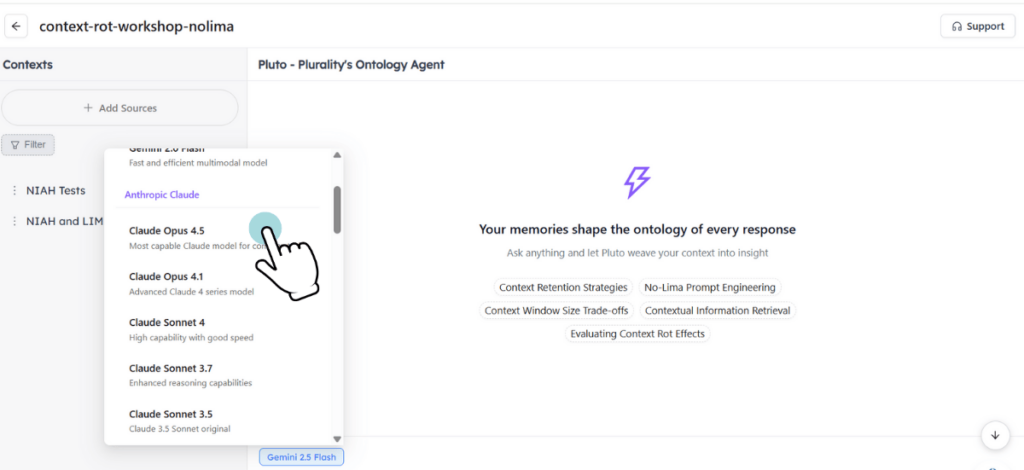
Option A: Use Memory Studio and Switch Between 30+ Agents
- Switch between more than 30 specialized AI agents without losing context within Memory Studio.
- Keep brand parameters, workflows, and preferences persistent across agents.
- Move seamlessly between research, strategy, writing, and analysis tasks within Pluto.
Option B: Use with Existing Chat Agents
- Apply context buckets directly through the browser extension.
- Inject context automatically before each conversation starts.
- Maintain consistent outputs across different AI tools with a portable AI context.
- Works with ChatGPT, Claude, Gemini, Perplexity, and Grok.
Read the 5-minute setup guide.
Step 5: Refine and Expand Over Time
As you work with the system, add nuances you discover about brand voice, update campaign parameters, and refine your context buckets. The system learns and improves with use, becoming increasingly valuable as your stored context becomes more comprehensive.
How Universal Memory Addresses Content Team Challenges
Eliminates Agent Switch Toll: Brand voice parameters travel with you when moving between ChatGPT, Claude, or other platforms mid-project, eliminating productivity loss from context reconstruction.
Prevents Content Overlap: Universal memory serves as a single source of truth, ensuring multiple team members work from identical brand parameters and eliminating duplicate briefing efforts.
Manages Multi-Brand Complexity: Organized context buckets provide each client with dedicated memory space and distinct parameters, preventing cross-contamination between Brand A and Brand B.
Reduces Brief Fatigue: Creative teams reclaim mental energy previously spent on repetitive explanations and redirect it toward strategic thinking and compelling content creation.
Benefits of AI Context Flow For Multi-Brand Content Teams
AI Context Flow delivers measurable productivity gains for agencies managing multiple client accounts. Teams report a 40-60% reduction in time spent on AI briefing and context-setting. This translates to faster turnaround times, increased output volume, and more bandwidth for strategic work that drives client results.
Brand voice consistency improves dramatically when AI has persistent access to comprehensive brand parameters. Agencies using AI for advanced market segmentation and content personalization find that a consistent brand voice across segments strengthens overall brand recognition. Good data, better marketing isn’t just a concept but the practical reality when AI tools work from a complete, accurate brand context rather than fragmented, repeatedly re-entered information.
For agency teams, AI Context Flow is an essential tool for tracking multi-brand campaigns. While it doesn’t replace project management platforms, it ensures the creative execution remains on-brand across all deliverables. This consistency becomes especially valuable during complex campaigns involving multiple content formats, platforms, and audience segments.
The collaborative benefits extend beyond individual productivity. When teams share context buckets, new members can instantly access institutional knowledge about brand voice. Onboarding time decreases, and junior team members can produce brand-consistent content faster because they’re working from the same comprehensive brief as senior staff.
Functional Aspects: Technical Components Routing Right Context To Chat Agent
Context Buckets: Organized Memory for Every Brand
Context buckets represent the core organizational principle of AI Context Flow. Each bucket functions as a dedicated memory space containing all relevant information for a specific brand, client, or campaign. Rather than storing everything in a single massive repository, context buckets allow you to maintain clear separation between projects while keeping related information together.
The information you include (tone guidelines, brand values, audience demographics, and campaign objectives) serves as the lens through which the AI understands and responds to your requests. This targeted context delivery ensures the AI focuses on relevant parameters without being overwhelmed by unrelated information from other clients or campaigns.
Selective Context Activation
The power of context buckets lies in selective activation. When you open a chat agent, you choose which context bucket to activate for that conversation. This selection tells the AI exactly what framework to operate within.
- Working on a casual social media campaign for Client A? Activate that context bucket.
- Switching to formal thought leadership content for Client B? Change the active context bucket, and the AI’s output immediately adapts to match the new parameters.
- Press optimize after writing your query to bring in your relevant context from the activated bucket.
This selective approach solves a critical problem: unrelated noise. Rather than feeding the AI everything you know about every client, you provide only the relevant context for the current task. The chat agent can pause and respond based on the information shared, rather than independently determining what to prioritize. This focused context delivery produces more accurate, on-brand outputs because the AI isn’t sorting through irrelevant information to identify what matters for the current request.
Context Bucket Management
Effective context bucket management evolves with your needs. Initially, you might create one bucket per client. As your relationship deepens and you manage multiple campaigns for the same client, you might create campaign-specific buckets that inherit core brand parameters while adding campaign-specific elements, such as messaging angles, product details, or time-sensitive promotional information.
The flexibility of context buckets accommodates various organizational approaches. Some teams prefer detailed, comprehensive buckets that include everything about a brand. Others maintain lean buckets with only essential parameters, supplementing with specific instructions during individual conversations. Both approaches work. The key is consistency within your team, so everyone knows which information lives in shared context buckets and which needs to be specified per request.
How Context Flows to Your Chat Agent
When you activate a context bucket and begin a conversation, AI Context Flow seamlessly injects the stored parameters into your chat environment. To the AI, it’s as if you started the conversation with a comprehensive brief. But from your perspective, you simply selected a bucket and asked your question. This invisible handoff eliminates friction while maintaining transparency. You always know which context is active, and you can refine or modify the individual contents of memory at any time.
The technical implementation respects the distinct capabilities of different chat agents. Whether you’re using ChatGPT, Claude, Gemini, or other supported platforms, AI Context Flow formats and delivers the synced context in ways optimized for each specific AI. This platform-aware approach ensures your brand parameters translate effectively across different AI architectures, providing consistent results regardless of which tool you prefer for particular tasks.
Universal AI Memory Is The Best Solution For Content Teams
For marketing teams serious about maintaining brand consistency while leveraging AI’s creative capabilities, universal AI memory isn’t optional but essential infrastructure. The alternative, manually re-establishing context with every agent switch, simply doesn’t scale as AI becomes more central to content workflows. Teams that adopt universal memory gain compounding advantages: faster production, better consistency, reduced brief fatigue, and more mental energy for creative strategy.
Ready to eliminate brand voice disconnect and reclaim hours lost to repetitive AI briefing?
Frequently Asked Questions
How does AI streamline content workflows for marketing teams?
AI automates repetitive writing tasks and generates rapid first drafts. With AI Context Flow’s universal memory, it maintains a consistent brand voice across outputs, eliminating revision cycles and enabling teams to produce more quality content faster.
How does AI memory help maintain brand voice consistency?
AI memory stores comprehensive brand parameters (tone, values, terminology, style). It makes them persistently available across all interactions, ensuring every output begins with a complete brand context rather than manual re-entry.
What is context switching in content marketing teams?
Context switching occurs when team members move between different tasks, clients, brands, or tools, requiring mental reorientation to remember relevant brand voice, campaign objectives, audience expectations, and tactical requirements.
Why does context switching slow down multi-brand marketing?
Each brand requires a distinct voice and messaging frameworks. Without AI memory, marketers must verbally communicate this shift through lengthy briefings, adding 5-10 minutes per brand switch and cumulatively costing hours of daily productivity.
How do AI tools manage multiple brand voices?
Advanced AI tools use structured context management systems, such as context buckets, that store distinct brand parameters for each client and apply the appropriate parameters based on the brand the user is currently working on.
How do marketing teams use AI to reduce repetitive briefs?
Teams implement universal memory systems that store standard brand information, style guidelines, and campaign parameters. Future interactions automatically access this stored context, eliminating the need for preliminary briefings.
What data should AI remember for brand-consistent content?
AI should remember core brand voice parameters, brand values, target audience, preferred terminology, sentence structure preferences, visual references, campaign messaging, product details, competitive positioning, and past successful content examples.
How do agencies use AI for multi-brand content management?
Agencies create organized context systems where each client has dedicated memory spaces. When working on Client A, they activate Client A’s context bucket, ensuring outputs match that brand’s voice and preventing cross-contamination.
Can AI improve collaboration across marketing tools?
AI serves as an intelligent bridge between platforms. Universal memory systems allow context established in one tool to inform work in another, creating continuity across the marketing stack regardless of which specific tool is used.
How does AI deliver measurable impact for non-technical marketing teams?
AI delivers tangible productivity improvements for freelancers by saving time on content creation, increasing output volume, reducing revision cycles, and accelerating campaign launches, all without requiring coding knowledge or technical configuration.