



- What is AI Long-Term Memory?
- How Does AI Memory Work?
- Which AI Platforms Have Memory Features?
- What Are the Limitations of AI Memory? 4 Major Challenges in 2025
- How AI Memory Creates Platform Lock-In: The Competitive Moat Strategy
- Why Use Multiple AI Agents? Choosing the Best AI for Each Task
- What is Universal AI Memory? Portable Context Across All Platforms
- Open Context Layer: A Universal, Portable Memory System for AI Agents
- Breaking Down the Walled Gardens of AI Memory
- Frequently Asked Questions
AI Long-Term Memory: How Universal Memory Solves Platform Lock-In
By Hira • Dec 02, 2025
Tl:dr; AI memory has evolved from nonexistent to platform-specific to universal. Early AI agents couldn’t remember anything between sessions. Now, ChatGPT, Claude, Gemini, Microsoft Copilot, and Grok all have memory, but each platform locks your context within its system. This creates strong user retention mechanics but prevents switching between tools. We have built a universal AI memory system, AI Context Flow, that solves this by maintaining a single portable memory across all platforms, letting you use the best AI for each task (Claude for analysis, ChatGPT for writing, Gemini for Google Workspace) without losing personalization or starting over.
Looking for a universal long-term memory solution that lets you move between agents without having to re-explain anything?
What is AI Long-Term Memory?
AI long-term memory is a system that allows AI agents to remember and reuse the information from past interactions across multiple sessions. When ChatGPT launched in late 2022, it became the fastest-growing consumer product in history. A computer program that could understand you and talk back to you? A seemingly intelligent non-biological entity that you could have real conversations with? This was revolutionary, and millions of people became immediately hooked.
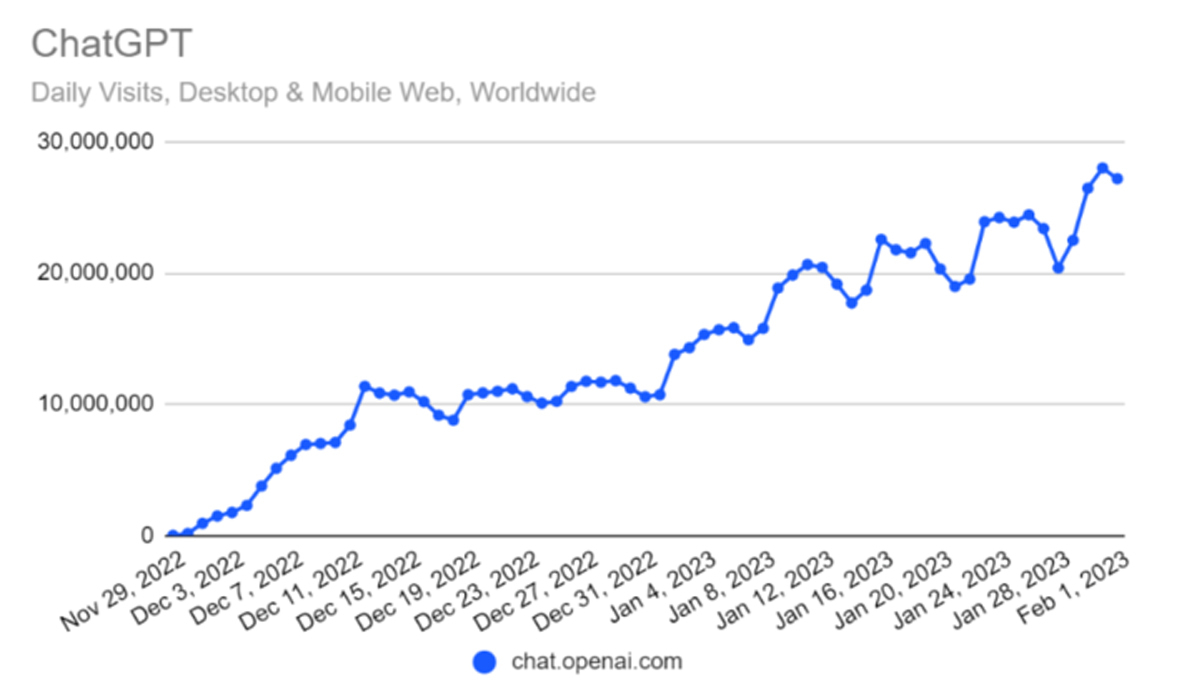
User Growth Chart of ChatGPT
However, as we all started having more conversations with these seemingly intelligent chatbots, one critical limitation became clear: AI agents (e.g., ChatGPT, Claude, Gemini, etc.) lack persistent memory between sessions. “AI long-term memory” is totally non-existent in these chat agents.
Each interaction felt like meeting someone with complete amnesia, helpful in the moment, but unable to remember anything from your previous conversations. The lack of persistent AI long-term memory blocks the creation of truly helpful, personalized AI assistants.
How Does AI Memory Work?
AI agents like ChatGPT and Claude are powered by Large Language Models (LLMs), which are fundamentally stateless. They don’t inherently remember anything from one conversation to the following, and only answer queries one prompt at a time.
To simulate AI memory within a single conversation, these systems use a workaround: they send the entire conversation history along with your newest query or prompt back to the model. This creates the illusion of continuity, but it’s incredibly inefficient, wasting tokens, increasing costs, and hitting context window limits as conversations grow longer.
Until recently, each AI interaction (i.e., a prompt) was essentially a fresh start, with the agent having zero knowledge of who you are, what you’ve discussed before, or what your preferences might be.
Now, this is starting to change as the industry recognizes that long-term memory in AI is essential for creating handy AI assistants.
Which AI Platforms Have Memory Features?
The early days of conversing with AI agents were like working with an energetic, passionate intern suffering from severe amnesia, one that forgets tasks you assigned yesterday, doesn’t recall important details you shared last week, and frequently misinterprets instructions mid-conversation.
“Intelligence alone isn’t enough without memory.”
Major AI platforms see this and are now embracing persistent memory as a core feature rather than an afterthought.
Here’s an overview of what memory features are currently being offered in various AI platforms:
| PLATFORM | MEMORY FEATURES | AVAILABLE SINCE | AVAILABILITY | KEY CAPABILITIES | USER CONTROL |
|---|---|---|---|---|---|
| ChatGPT | Dual System: “Saved Memories” + “Folders” | Feb 2024 (upgraded Apr 2025) | Free: Lightweight short-term Plus/Pro: Full long-term |
References all past conversations; automatic learning; project-scoped memory. | View, edit, and delete individual memories; toggle off in settings; "Temporary Chat" mode available. |
| Claude | Project-scoped persistent memory | Sep 2025 | Team, Enterprise, Pro, and Max plans | Automatic context retention within projects; isolated memory per project; import/export capability. | View, edit, and delete memories; project-level control; incognito chat mode can be fully disabled. |
| Gemini | “Saved Info” with cross-chat recall | Nov 2024 | Advanced users only | Remembers preferences, interests, work details; cross-chat context reference. | View, edit, and delete from a dedicated "Saved Info" page; transparency when info is used; toggle off anytime. |
| Microsoft Copilot | Dual: Memory + Custom Instructions | Jul 2025 | M365: Enterprise/Team/Pro | Learns working style, preferences, recurring topics; contextual across Microsoft apps; "memory updated" signals. | View, edit, and delete from settings; tenant-level admin controls for Enterprise can be fully disabled. |
| Grok | Persistent memory with Workspaces | Apr 2025 (beta) | Not available in EU/UK | Remembers past conversations, personalized recommendations, and Workspace-organized contexts. | Transparent list of memories; delete individually; toggle off “Personalize with Memories; not integrated with X yet.” |
The above table was last updated in November 2025.
These developments mark a fundamental shift.
“AI memory is no longer experimental; it’s becoming table stakes for competitive AI products.”
What if you could have one memory that works across all of the above agents?
What Are the Limitations of AI Memory? 4 Major Challenges in 2025
Despite these advances, significant AI memory limitations remain. Current implementations face several challenges:
1. Context Window Constraints
Even the most advanced models have finite context windows. While Claude 4 and GPT-4 can handle hundreds of thousands of tokens, extremely long conversation histories still hit limits, forcing the system to “forget” earlier parts of the conversation.
2. Retrieval Accuracy
As examples of limited memory AI demonstrate, not all stored information is equally accessible. Current systems may struggle to surface the right memory at the right time, sometimes recalling irrelevant details while forgetting crucial context. Two recent research problems indicating a retrieval accuracy problem in large contexts are (a) Context Rot and (b) Lost in the middle. Both point to the same conclusion: accurate retrievals are trickier than they look.
3. Cross-Platform Fragmentation
Perhaps the biggest limitation is that AI memory remains siloed within individual platforms. Your ChatGPT memory doesn’t transfer to Claude, and your Gemini preferences don’t follow you to Grok. This creates friction and lock-in. AI without memory creates significant challenges as users lose continuity when switching between tools.
4. The AI Memory Wall
Industry experts have begun discussing the “AI memory wall“, a fundamental bottleneck where traditional approaches to storing and retrieving context don’t scale to the complexity of real human relationships and work patterns. The limits of memory are now the biggest threat to AI innovation stagnation in the upcoming years.
How AI Memory Creates Platform Lock-In: The Competitive Moat Strategy
With over 1 billion users now relying on AI agents regularly, a subtle but powerful retention mechanism has emerged: memory-based platform lock-in.
The AI Memory Trap
As Google’s AI Overviews reach 2 billion monthly users and platforms like Perplexity redefine search as “answer engines,” one factor prevents users from switching between ChatGPT, Claude, Gemini, and other platforms: AI memory.
Consider an AI agent that knows your preferences, work style, communication patterns, and workflows. Switching to a new platform means teaching the new agent everything from scratch. This process can take hours or weeks of re-explaining context, thereby deterring users from switching platforms.
Lack of Persistent AI Memory Makes Agent Switching Hard
Think of replacing a personal assistant who perfectly understands your needs. Would you voluntarily start over? Most won’t. This is the sunk cost fallacy in action: the time invested in one AI makes abandoning it feel wasteful and frustrating.
Once users experience personalized, continuous interactions, switching becomes exponentially harder.
“The more an AI knows about you, the more valuable and irreplaceable it becomes.”
AI Memory as a Retention Strategy
This creates a powerful competitive moat: AI long-term memory isn’t just a feature, it’s a deliberate retention strategy. But one that raises a critical question: Should users stick to one platform, or does the future require using multiple specialized AI agents for different tasks?
Why Use Multiple AI Agents? Choosing the Best AI for Each Task
Different AI agents excel at different tasks. Claude might be superior for complex reasoning and analysis. ChatGPT might handle creative writing better. Grok might offer more current information with real-time web access. Gemini might integrate better with your Google Workspace.
“In an ideal world, you’d use the best tool for each specific job, switching seamlessly between agents based on the task at hand. But the current state of AI memory makes this impractical.”
But what if we could have one memory layer that works everywhere?
The universal memory layer for all your AI agents. No lock-in. Fully portable.
What is Universal AI Memory? Portable Context Across All Platforms
Memory has become AI companies’ primary retention tool, creating platform lock-in similar to early social media. If you built a follower-following graph on one social network, moving to another platform felt like starting over in social isolation. Similarly, moving to a new AI agent feels like losing all the personalization you’ve carefully built up over time – the classic cold-start problem.
This is especially acute in AI companionship applications, where switching agents can feel like abandoning a friend or companion, creating real emotional consequences. Research has documented users experiencing genuine grief when they can’t transfer their relationship with an AI to a different platform, with some even holding memorials and mourning rituals when companion apps shut down.
Reimagining AI Memory as Portable Data
What if AI memory existed outside any individual agent: free to move and plug in wherever you go?
Consider how we think about data storage. For decades, we viewed memory as a hard disk embedded deep within our computer devices, fixed, permanent, and tied to that specific machine. But portable hard drives changed that paradigm completely.
“External drives, cloud storage, and USB devices made our data portable and device-independent. Why can’t AI long-term memory work the same way?”
This is where Universal AI Memory comes in.
What does Universal AI Memory Solve?
A universal AI memory layer functions differently from platform-specific implementations. Rather than each AI platform maintaining its own isolated memory of your interactions, a universal system creates a standardized context layer that any agent can query.
This architectural approach solves multiple AI memory limitations simultaneously:
- Selective Retrieval: Rather than forcing the AI to process every past interaction, the system intelligently surfaces only relevant memories for the current context, avoiding token waste and context window overflow.
- Cross-Platform Learning: Insights gained from one AI agent can inform interactions with others. If you teach Claude about your writing style, ChatGPT can leverage that same knowledge.
- Persistent Evolution: Your memory grows and refines over time across all platforms, creating an increasingly sophisticated understanding of your needs, preferences, and working style.
Privacy and Security in Universal AI Memory Systems
A critical consideration for any AI universal long-term memory system is privacy and security.
“When your context, preferences, and personal information become portable and persist long-term, protecting that data becomes critical.”
Universal long-term AI memory systems must implement robust encryption, user-controlled access controls, and transparent data-handling practices. This layer should be designed with privacy-first principles from the ground up, rather than retrofitted onto existing platforms with conflicting business incentives around data collection.
Who Needs a Universal Memory Solution?
60% of knowledge workers now regularly use more than 3 AI agents and select the best tool for the job. However, they keep running into problems like
Scenario 1: Work
You tell ChatGPT your writing style → Claude doesn’t know it.
Scenario 2: Productivity
You track tasks in Copilot → Gemini has no clue.
Scenario 3: Personal
You explain preferences to Grok → ChatGPT starts from zero.
A universal memory system that works across AI agents is especially useful for:
- Freelancers who manage multiple client projects and hate repeating requirements every chat
- Researchers who research with AI and spend 10 minutes per session setting context
- Marketers who create content and need a consistent brand voice across 100+ conversations
- Developers who code with AI daily but keep re-typing their tech stack and architecture
- People using multiple AI agents daily and keep repeating details
Belong to one of the above categories? See how Plurality Network’s browser extension enables one memory across all your AI agents.
Open Context Layer: A Universal, Portable Memory System for AI Agents
What is the Open Context Layer?
Plurality Network has been pioneering work on an open context layer, a universal AI memory layer that plugs and plays with any AI agent seamlessly, acting as a long-term, persistent AI memory store.
Instead of training every agent individually and rebuilding your context from scratch on each platform, imagine adding your data, your thoughts, your files, and your bookmarks to a centralized memory system that can be plugged into any agent platform, attaching only the granular data permitted by the user’s permissions. That’s what an Open Context Layer is.
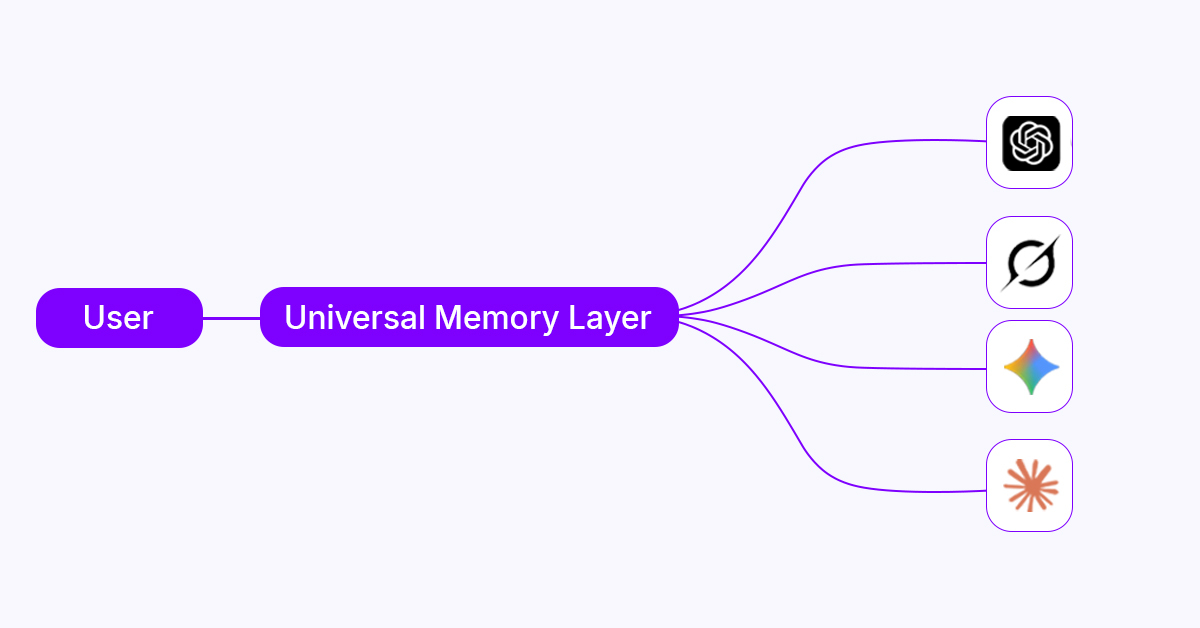
User → Universal Memory Layer → ChatGPT / Claude / Gemini / Grok
AI Context Flow: The Browser Extension for One Memory Across All Agents
AI Context Flow is a browser extension that enables you to use one unified memory across all major AI agents, including ChatGPT, Claude, Grok, Gemini, Perplexity, and more. It solves the fragmentation problem by creating a standardized AI memory layer that sits between you and whatever AI tool you’re using.
This approach offers several transformative advantages:
- Platform Agnosticism
Use the best AI for each specific task without losing continuity or context. Switch from Claude for analysis to ChatGPT for creative writing, with your full memory following you.
- Data Sovereignty
Your memory and context belong to you, not locked in any company’s proprietary system. You control what’s remembered and what’s forgotten. Data sovereignty and AI personalization are fundamental to user-owned AI experiences.
- Consistency Across Tools
Whether you’re using AI in your browser, on mobile, or through API integrations, your memory layer provides consistent context everywhere.
- Reduced Redundancy
Instead of explaining your preferences to five different AI systems, you maintain one comprehensive memory that all agents can reference.
Ready to experience universal AI memory? See how Plurality Network’s browser extension enables one memory across all your AI agents.
Want to get started quickly? Follow our 5-minute setup guide to configure your universal memory system today.
Breaking Down the Walled Gardens of AI Memory
Key Takeaways:
- AI memory has evolved from nonexistent to → platform-specific to → universal, representing a fundamental shift in AI interaction.
- AI long-term memory is possible with universal memory systems, aka AI Context Flow, to eliminate platform lock-in and enable best-of-breed tool selection.
- Portable AI memory ensures context and personalization remain user-controlled, not trapped in company ecosystems.
The transition from platform-specific to universal AI memory is already beginning. Early adopters are experimenting with tools that provide cross-platform context management.
As this technology matures, we can expect to see broader adoption and standardization. Industry collaboration on memory portability standards, similar to how OAuth standardized authentication, could accelerate this shift dramatically.
For users and organizations looking to avoid lock-in while maximizing the value of their AI investments, exploring universal AI memory layer solutions represents a strategic advantage.
Frequently Asked Questions
What is AI long-term memory?
AI long-term memory is a system that allows AI agents to store, recall, and utilize information from past interactions across multiple sessions. Unlike traditional stateless AI models that forget everything after each conversation, long-term memory enables AI to remember user preferences, past conversations, and contextual information, creating more personalized, continuous experiences.
How does AI memory work?
AI memory stores conversation history and user data, either parametrically (within the model’s weights) or non-parametrically (in external databases). When you interact with an AI, the system retrieves relevant past information and includes it in the current context, allowing the AI to provide responses that account for your history, preferences, added data/files, bookmarks, and previous interactions without requiring you to repeat information.
What are the main AI memory limitations?
The primary AI memory limitations include context window constraints (even advanced models can only process a finite amount of information at once), retrieval accuracy issues (systems may struggle to surface the right memory at the right time), cross-platform fragmentation (memory doesn’t transfer between different AI services), and the “AI memory wall” where traditional approaches to storing and retrieving context don’t scale to complex human relationships and work patterns.
What is a universal AI memory layer?
A universal AI memory layer is a portable memory system that exists independently of any specific AI platform. It acts as a centralized context database that any AI agent can access, allowing users to maintain consistent personalization and knowledge base across multiple AI services like ChatGPT, Claude, Gemini, and Perplexity without being locked into a single platform.
Which AI platforms currently have memory features?
As of 2025, several major AI platforms have implemented memory features: OpenAI’s ChatGPT remembers user interactions across sessions; Anthropic’s Claude 4 models include long-term memory capabilities; Google’s Gemini offers memory features for Advanced users; Microsoft’s Copilot suite has memory functionality; and xAI’s Grok includes memory features. However, these memories are platform-specific and don’t transfer between services, leading to platform lock-in. You can use AI Context Flow to turn on to turn on cross-platform AI longterm memory.
Can AI memory transfer between different platforms?
Currently, AI memory cannot natively transfer between different platforms. Each AI service maintains its own isolated memory system. However, emerging solutions like universal memory layers and tools such as AI Context Flow are being developed to enable portable memory that works across multiple AI agents, solving the fragmentation problem.
How does the Gemini AI memory feature work?
The Gemini AI memory feature allows Google’s AI assistant to remember important information from your conversations, including your preferences, interests, and relevant personal details. Available to Gemini Advanced users, this feature enables more personalized responses over time as Gemini learns from your interactions and applies that knowledge to future conversations.
How can I prevent AI platforms from locking me in with memory?
To avoid platform lock-in through AI memory, consider using universal memory solutions that work across multiple platforms, regularly export your conversation data and preferences, document your important interactions and preferences independently, and advocate for memory portability standards. Additionally, using open-source or platform-agnostic memory systems can give you more control over your AI context and data.
What is AI Context Flow?
AI Context Flow is a browser extension developed by Plurality Network that creates a universal memory layer for AI agents. It allows users to maintain a unified memory across all major AI platforms, including ChatGPT, Claude, Grok, Gemini, and Perplexity, enabling seamless switching between AI services without losing personalization or context.