



- What Is an AI Memory Extension and Why ChatGPT & Claude Forget You
- The Real Problem: Why Switching Between AI Tools Breaks Your Context
- How Universal AI Memory Extensions Solve Context Loss
- Meet the Top 4 AI Memory Extensions of 2026
- Best AI Memory Extension Tools to Extend Memory in Chatbots or AI Systems
- How These Tools Compare on Key Features
- Which AI Memory Extension Should You Choose?
- Feature Comparison
- Conclusion
- Key Takeaways
Best AI Memory Extensions for ChatGPT, Claude and Gemini (2026 Comparison)
By Hira • Feb 10, 2026
What Is an AI Memory Extension and Why ChatGPT & Claude Forget You
ChatGPT, Claude, Gemini, and Perplexity are powerful, but they all suffer from the same fundamental flaw: they forget everything about you the moment you switch tools, start a new chat, or hit a token limit.
If you’ve ever:
- Explained your project to ChatGPT
- Switched to Claude for better writing
- Opened Gemini for current information
…you already know the pain: you have to start over every time.
This is not a user error. It’s how large language models are built.
By default, ChatGPT has no long-term memory, Claude does not share context across chats, and Gemini forgets your preferences as soon as the session ends.
That is why a new category of tools has emerged:
AI memory extensions.
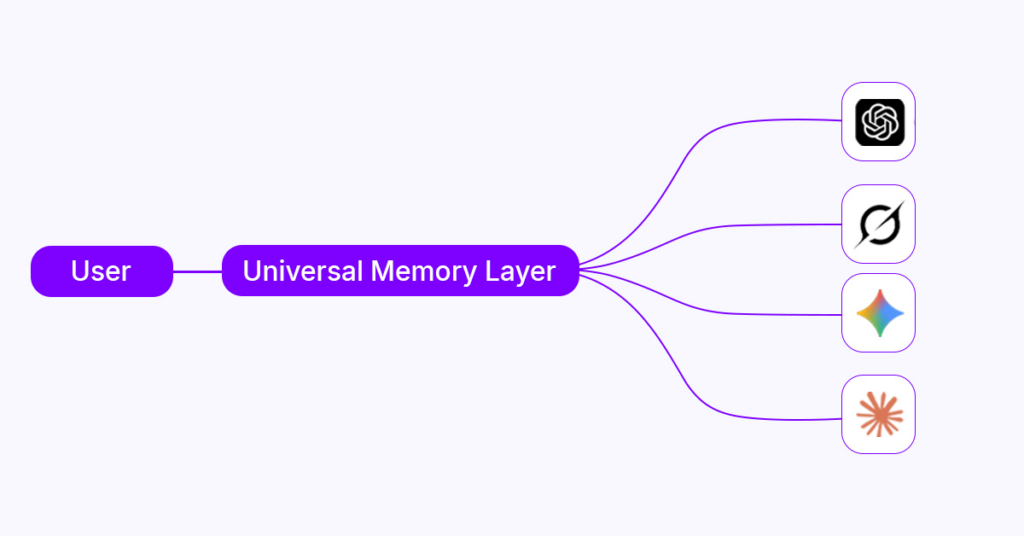
These tools create a universal, long-term memory layer that sits above ChatGPT, Claude, Gemini, Perplexity, and other AI assistants. Instead of every model working in isolation, your context, preferences, projects, and knowledge follow you across every AI you use.
In this guide, we compare the four leading AI memory extensions of 2026:
- AI Context Flow – a universal memory layer that works across all major AI platforms
- MemSync – a research-grade memory system with semantic and episodic recall
- myNeutron – a Chrome-based AI memory that captures everything you do online
- Memory Plugin – a lightweight long-term memory add-on for LLMs
We’ll look at:
- Which one works with the most AI tools
- Which one has the best long-term memory
- Which one is safest for privacy
- And which one is best for your workflow
If you are tired of re-explaining yourself to every AI assistant, this comparison will show you how to turn disconnected chats into a single continuous AI brain.
The Real Problem: Why Switching Between AI Tools Breaks Your Context
The reality of working with AI tools hits hard: even models with superhuman abilities remember about as much as a goldfish. These systems have grown faster in reasoning and creative skills, but they face a core design limitation – they forget almost everything between sessions. Users face a frustrating situation where they must repeatedly teach AI systems things they should already know.
The frustration of repeating yourself to AI tools
“It’s not a bug, it’s a feature.” This uncomfortable truth stems from AI memory limitations being intentional design choices. AI APIs follow stateless principles where each call stands alone i.e. they meet you for the first time, every time. The result creates a strange productivity puzzle: sophisticated AI tools can solve complex problems instantly but don’t know how to remember working with you yesterday.
Users must rebuild context constantly. You might spend hours with Claude developing a crypto trading strategy, explaining your risk tolerance, entry signals, and stop-losses. Switching to ChatGPT means starting fresh. Your trading chance often disappears by the time you rebuild that context.
This forgetfulness creates several big problems:
- Wasted Time: Professionals spend 200+ hours annually re-explaining preferences and project context
- Inconsistent Experiences: AI responses lack individual-specific experiences and continuity
- Broken Workflows: Complex multi-step processes become scattered and disconnected
- Loss of Trust: Systems that keep forgetting damage user confidence
Crypto traders aren’t the only ones feeling frustrated. Developers lose their place when switching between coding assistants. Analysts must copy-paste or rebuild their knowledge base with each new AI tool. Regular users find themselves saying the same things over and over. This creates what experts call “multi-agent orchestration with session management challenges”, which means AI tools don’t work well together over time.
Why token limits and session resets break continuity
Two related constraints cause this problem: token limits and environment resets.
Token Limits
Token limits set the maximum combined tokens allowed in a single interaction. The system cuts off or skips earlier context when exceeded, making the AI seem forgetful. Longer conversations naturally collect tokens faster, raising the risk of losing important context.
Each AI model handles tokens differently. GPT-4 started with 8,192 and 32,768 tokens, while GPT-4 Turbo expanded to 128,000. Newer models like GPT-4.1 support up to 1 million tokens. But even with these impressive numbers, a phenomenon called context rot prevents models from using their context windows effectively.
Performance gets worse as context grows longer. Research shows top language models struggle more with retrieval tasks as context expands. GPT-4’s accuracy falls from 99% to 70% with 32,000 tokens. Claude 3.5 Sonnet drops more sharply from 88% to just 30%. Complex reasoning tasks that need multiple steps make this decline even more obvious.
AIMultiple’s comprehensive analysis of 22 leading AI models found that “smaller models often beat their larger counterparts, and most models fail well before their advertised limits.” Their research shows the efficiency ratio, i.e. how much of each model’s advertised context window actually works in practice, reveals significant gaps between theoretical capacity and practical performance.
Environment Resets
Environment resets create another annoying break in continuity. ChatGPT users report automatic environment resets happening multiple times, even during the same chat. They must reupload files and rebuild context several times daily, with some saying resets happen “about once per hour”. These resets especially hurt analytical and coding work where the system wipes the entire execution state without warning.
This forced forgetting creates a structural problem for any long-term AI workflow. Major AI systems don’t keep memories between sessions, so users must manually track updates, store history, craft careful prompts, and create continuity through external tools like Zapier, Notion, or custom code.
How Universal AI Memory Extensions Solve Context Loss
The “memory wall” stands as the main obstacle to building lasting AI memory. AI’s computing power has grown much faster than hardware memory capabilities. All the same, the urgent need for continuous AI memory has sparked new solutions.
Portable or Universal AI memory looks like a promising fix for these limitations. These tools create a universal, lasting memory layer that follows users across different AI platforms and assistants. Users can own and control their AI context instead of being stuck with single systems like ChatGPT or Claude.
Businesses see clear value in these tools. Customer support teams can instantly access a user’s past issues, priorities, and purchase history, which cuts resolution time and reduces frustration. Mental health applications spare users from telling their emotional story again when trying new therapists or apps.
Some solutions like Mem0 say they reduce prompt tokens by up to 80% while making responses better, scoring 26% higher than OpenAI’s built-in memory with 90% fewer tokens. This suggests portable memory improves more than just continuity, it makes everything work better.
The change brings challenges too. Human identity comes from continuous experience, but AI systems are built specifically to prevent persistence and change. This creates tension between our need for coherent, ongoing AI interactions and the industry’s focus on control and predictability.
Leading AI systems will keep facing this core limitation as long as their architecture makes them forget, reset, and stay disconnected. The 87% of crypto users who would trust an AI with part of their portfolio and countless others using AI for complex work all hit the same wall: systems that can’t remember yesterday’s actions.
This context crisis goes beyond mere inconvenience, it fundamentally threatens enterprise AI adoption. Organizations are “building on sand” without fixing this basic problem, creating expensive pilots and fragile prototypes instead of solid, reliable systems.
New AI memory extensions are emerging to bridge this gap, creating the lasting context needed for truly productive AI workflows. These tools mean more than convenience, they’re changing how we interact with artificial intelligence by solving AI’s basic memory problem.
Meet the Top 4 AI Memory Extensions of 2026
2025 brings a fresh wave of tools to tackle the AI memory problem. These browser extensions and memory layers create lasting context that follows you across AI platforms, so you won’t need to repeat yourself.
AI Context Flow: Real-time context sync across assistants
AI Context Flow acts as a universal memory layer that moves with you between ChatGPT, Claude, Gemini, Perplexity, and Grok. This browser extension builds a smooth bridge between AI platforms of all types, letting your context follow you everywhere.
AI Context Flow’s breakthrough lies in its ability to save context once and use it with different chat agents. This Chrome extension gives you an AI assistant with long-term memory that knows who you are, what you want, and how you prefer to work.
The setup process takes a few minutes. You can sign up with MetaMask, Google, or Email after installation to access the memory studio where your memory buckets live. These buckets work with any AI agent. You can press Ctrl+I to optimize your prompt right away, using stored AI memory to improve responses based on your knowledge and priorities.
AI Context Flow shines by turning conversations into reusable knowledge. Your interactions can be saved in new or existing memory buckets, which adds them to your AI assistant’s long-term memory. The tool handles multiple file formats (.txt, .json, .docx, .md, and .pdf), so your AI can process data whatever the format. Any blog snippet, any paragraph from any website can be highlighted and saved to your desired memory bucket.
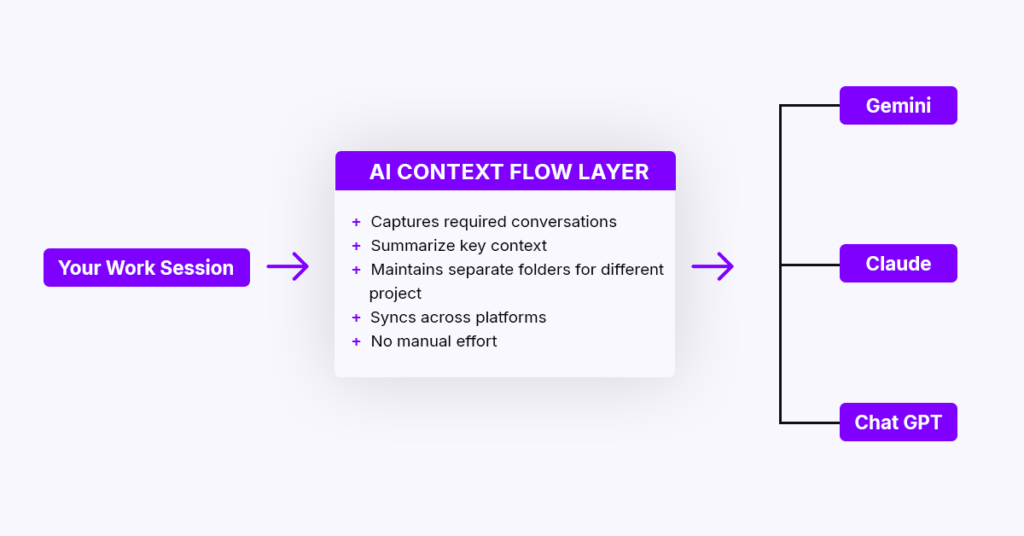
Freelancers with multiple clients will find AI Context Flow eliminates the hassle of context-switching. They can create a client memory profile once instead of teaching every AI tool about each client repeatedly. This portable context layer works like an external hard drive for AI context that stays persistent, independent, and reusable across environments.
Download AI Context Flow to see how a universal AI memory layer can boost your productivity across AI platforms.
Automate your context switching!
Try AI Context Flow to see how a universal AI memory layer can boost your productivity across AI platforms.
MemSync: Dual-layer memory with semantic and episodic recall
OpenGradient, an a16z crypto-backed AI infrastructure company, created MemSync with a psychological approach to AI memory. MemSync splits memories into two types: semantic and episodic.
Semantic memories create the stable foundation. These are long-term facts and traits that stay consistent:
- Core identity information (“Born in London”)
- Long-term contextual information (“Works in tech”)
- Fundamental priorities and traits (“Interested in cooking”)
- General facts not tied to specific events (“User is fluent in English and Spanish”)
Episodic memories capture life in motion e.g. current situations, active projects, and changing circumstances:
- Current activities and skills being developed
- Recent events and experiences
- Ongoing projects and deadlines
This dual-layer approach solves a common problem in memory systems: too much data becoming unmanageable. MemSync uses four key operations to keep balance: CREATE (forms new memories), UPDATE (modifies existing ones), REINFORCE (strengthens important memories), and DELETE (removes outdated information).
The system retrieves information through three stages: vector search finds semantically related memories, contextual precision ranking determines specific relevance, and an optimization layer balances foundational and current memories .
Tests showed MemSync 243% superior memory performance compared to existing solutions, reaching 0.7344 accuracy versus the industry standard of 0.2141 (OpenAI’s solution).
myNeutron: Unified memory across Chrome and AI tools
MyNeutron turns your browser into an AI-ready workspace that captures, organizes, and understands everything you see, read, and write online. This tool uses advanced semantic AI to store information with meaning, not just text.
MyNeutron works quietly in Chrome and captures pages, emails, documents, and chats you use. It interprets them using semantic search and artificial intelligence memory techniques to create an interconnected knowledge network.
The tool stands out by serving as a unified memory system across Chrome and AI platforms. Users can store prompts, recall past conversations, maintain context throughout sessions, and develop an AI that understands them.
myNeutron uses the terminology of “seeds” which are essentially memories. You can capture full pages, or conversations and can “seed” the future conversations with relevant memories.
The storage of memories is done on Vanar Blockchain to provide a persistent, decentralized storage and you can pay for its subscription through vanar tokens as well.
The extension builds a lasting bridge between ChatGPT, Claude, Gemini, and other AI tools as a continuous context provider. MyNeutron connects with your favorite AI assistants instead of replacing them. Scattered history becomes instant, applicable information, with data organizing itself into “Bundles” that let you ask natural questions, get insights, and feed perfect context into all your AI tools.
Memory Plugin: Lightweight memory injection for LLMs
Memory Plugin takes a focused approach to AI memory, designed to remember your personal trip and help you reflect on progress over time. This lightweight solution puts contextual memory directly into large language models.
The difference becomes clear in interactions. An AI might ask, “Would you like to start a new journal entry?” without Memory Plugin. With Memory Plugin, that same AI becomes contextually aware: “Based on your past entries, it seems you’ve made progress on your fitness goals. Would you like to reflect on that in today’s journal?”
This personal trip tracking makes Memory Plugin valuable to users who need continuity and personal growth monitoring. Its lightweight design improves efficiency while keeping the contextual awareness that makes AI interactions feel personal and relevant.
These four leading AI memory extensions help users break free from repetitive AI interactions. Each tool offers its own solution to context continuity, with different levels of technical sophistication, integration capabilities, and specific uses. Your workflow needs, preferred AI platforms, and required memory depth will determine the best tool for you.
Best AI Memory Extension Tools to Extend Memory in Chatbots or AI Systems
The tools above (like AI Context Flow and others) represent the best AI memory extension tools to extend memory in chatbots or AI systems available today. Each one addresses a different layer of the memory problem, from token limits to cross-session forgetting, and can be layered on top of any existing AI workflow without replacing your preferred assistant. Let’s take a further look now on how they compare on key features
How These Tools Compare on Key Features
Picking the right AI memory extension needs a good grasp of how these tools differ. AI Context Flow, MemSync, myNeutron, and Memory Plugin each have their own way of handling compatibility, memory storage, and user experience.
Cross-platform compatibility and assistant support
An AI memory extension’s worth depends on its platform support. AI Context Flow stands out with the best compatibility. It works with ChatGPT, Claude, Gemini, Perplexity, and Grok. Users can switch between platforms without losing any context.
MemSync has good cross-platform features too. It focuses on better performance rather than supporting every platform. Memory Plugin gives users more platform choices than most other tools through browser extensions, custom GPTs, NPM packages, and API integrations. Users can pick what works best for their needs.
myNeutron takes a different path. It mainly works in Chrome while connecting to various AI platforms. This creates a link between browsing and AI tools, though it supports fewer platforms than AI Context Flow.
Platform lock-in makes a big difference here. Traditional AI memory stays under provider control and works only in their systems. Universal memory tools like AI Context Flow let users control and access their memory across platforms.
Context injection methods: sidebar vs inline vs API
The way memory feeds into AI conversations shapes the user experience. These tools use three main methods:
Context injection adds relevant text passages into prompts for AI models. Each tool does this differently:
Dropdown Injection (AI Context Flow): Users get a special panel to pick which memory “buckets” they want in any conversation. This gives them full control over context.
Inline Injection (Memory Plugin & AI Context Flow): Puts relevant facts into conversations with one click. Users don’t need to do much.
API-Based Injection (MemSync): Uses smart systems to add only the most relevant memories based on the conversation. This balances efficiency and relevance.
Prompt Optimization
The technical implementation of how the context is injected into the prompt varies significantly. Some tools use simple prompt templates that prepend or append context:
Context: [Retrieved Memory]
Question: [User Query]
More sophisticated systems use structured input formats, accepting query and context as separate parameters. These technical differences directly impact how seamlessly memory integrates into conversations. AI Context Flow optimizes the prompt using State of the art (SOTA) techniques alongwith adding the context, invoking enhanced and better responses from the users. Memsync, memory plugin and myNeutron add the context after the query directly without doing any prompt optimization.
Memory types supported: short-term vs long-term
AI agents need different types of memory, just like humans do. Each tool handles memory in its own way:
AI Context Flow and Memory Plugin mainly use semantic and long-term memory (LTM). This keeps information across different sessions and helps personalize responses over time. Memory Plugin focuses on key facts rather than entire chat histories.
AI Context Flow will soon incorporate episodic memory as well.
MemSync uses two layers: semantic memory for stable facts and episodic memory for current situations. This matches how human memory works and helps store information better.
myNeutron builds a unified knowledge network through semantic memory. It uses advanced AI to understand information instead of just storing text.
All tools offer some short-term memory (STM) features. STM works like human working memory, holding information during conversations. This information usually disappears after sessions end.
Privacy and data control: local vs cloud storage
Privacy considerations vary substantially across these extensions:
AI Context Flow lets users control their memory fully. Users decide what stays and what goes. This beats platform-specific memory, where providers set all the rules. The extension uses encrypted data with user-held keys to ensure privacy.
Memory Plugin stores only specific facts and context needed for future talks, not full chat histories. This keeps things private while staying useful.
myNeutron captures everything you see, read, and write online. This gives rich context but raises more privacy questions.
Memsync uses hardware security modules to ensure users their data is safe and protected from manipulation.
Storage Spectrum:
- Cloud Storage: Most tools use cloud storage for cross-device synchronization
- Local-First: Some tools prioritize on-device storage
- Hybrid Approaches: Advanced options offer encrypted storage with user-held keys or hardware level security with Trusted Execution Environments
The tradeoff usually balances convenience against privacy. Cloud solutions work on all devices but might expose data. Local solutions keep things private but may limit what you can do. Encryption with user-held keys and hardware security with TEEs offer balance between convenience and privacy. Both AI Context Flow and Memsync strike this balance.
Ease of setup and user interface
Setup and user experience differ among these tools:
AI Context Flow needs just five minutes to set up, while platform-specific memory tools take 10-15 minutes. Users can sign up various ways to access their memory studio with all memory buckets.
Memory Plugin’s browser extensions work with one click, and its custom GPTs start automatically. Even non-tech users can handle it easily.
MemSync works best for developers. It needs more tech know-how but offers more customization. myNeutron fits right into Chrome, quietly gathering information as you browse.
- Each tool’s interface shows its priorities:
- AI Context Flow and Memory Plugin give users more control
- MemSync runs more automatically
- myNeutron blends into your normal browsing
Different users need different things. Some want simple tools, others want full control.
AI Context Flow wins at cross-platform support and user control. MemSync handles privacy and retrieval best. myNeutron integrates well with browsers. Memory Plugin offers the most ways to connect. Pick the one that matches your needs.
Which AI Memory Extension Should You Choose?
The right AI memory tool depends on your workflow and priorities. Each AI memory extension shines in different areas. Some tools work better for specific jobs and tasks.
Best for marketers: AI Context Flow or Memory Plugin
AI Context Flow is a great way to get value for marketing professionals who handle multiple clients. Marketers can save about 8 hours weekly on context management by creating client-specific memory buckets with brand guidelines, audience personas, and strategic goals. This boost in efficiency lets them take on more clients without working longer hours.
AI Context Flow helps marketers keep their brand voice consistent across multiple AI platforms during campaign optimization. One content creator used different AI agents based on their strengths i.e. ChatGPT for ideation, Claude for research analysis, and Gemini for current information. They cut their editing time from 45 to 15 minutes per piece while keeping their unique voice.
Memory Plugin gives similar benefits with a lighter setup. This makes it perfect for marketers who need quick context injection without complex configuration. Both tools create individual-specific customer interactions by remembering previous touchpoints and priorities.
Best for researchers and writers: MemSync
MemSync excels for researchers thanks to its sophisticated dual-layer memory system that works like human information processing . It smoothly maintains context across multiple AI applications. This feature makes it valuable for academic research, literature reviews, market analysis, and technical evaluations .
Writers and researchers often switch between AI services while working on complex projects. MemSync transfers memory smoothly and eliminates repetitive explanations. This boosts daily productivity significantly . Researchers working with sensitive information appreciate its privacy-focused design. Users retain control through session-signed keys.
Best for everyday users: myNeutron
MyNeutron is the most available solution for casual AI users who need continuity across popular platforms. Users love its simple Chrome extension setup. It works with “ChatGPT, Claude, Gemini, Perplexity, and more”.
The platform works with all major AI tools without needing specific configurations. Its privacy-first design keeps sensitive operations on your device. It also offers end-to-end encryption to address common AI data security concerns.
Feature Comparison Table
| Feature | AI Context Flow | MemSync | myNeutron | Memory Plugin |
|---|---|---|---|---|
| Platform Compatibility | ChatGPT, Claude, Gemini, Perplexity, Grok (more coming soon) | ChatGPT, Claude, Grok | Sits silently across all websites on chrome, connects to various AI platforms | Browser extensions, custom GPTs, NPM packages, API |
| Memory Type | Long-term memory with bucket system | Dual-layer (semantic and episodic) | Semantic memory with knowledge network | Focused long-term memory for specific facts |
| Context Injection | Inline injection with selective control through buckets | API-based with relevance ranking | Browser-based continuous capture | One-click inline injection |
| Storage & Privacy | User-controlled memory management | Cloud-based with sophisticated retrieval | Captures all online activity | Stores only specific facts |
| Setup Time | 5 minutes one-time | Some technical setup required → Install, then connect socials, setup prompt refinement settings etc. | Quiet browser integration | One-click activation |
| Best For | Marketers, multi-platform users, freelancers | Researchers, academic work | Everyday users, casual AI interaction | Content creators, light users |
| Key Advantage | Universal compatibility across platforms | 243% superior memory performance | Seamless browser integration | Multiple integration options |
| Pricing | Free with premium options | Not specified | Free with premium options | Free with premium features |
Conclusion
You no longer need to explain yourself repeatedly to different AI assistants. Four new AI memory extensions reshape the scene of our AI interactions. These tools create lasting context that moves with you across platforms. You can switch between ChatGPT, Claude, Gemini, and other assistants without rebuilding context. Your priorities, project details, and chat history stay intact throughout.
AI Context Flow excels with its wide platform compatibility and user’s memory bucket system. This solution works with almost all major AI platforms. It’s especially valuable when you have multiple clients or projects as a marketer or content creator. MemSync takes a different approach with its dual-layer memory system that works like human thinking. It works better than standard memory systems. myNeutron gives Chrome users uninterrupted integration. Memory Plugin keeps things simple with flexible setup options.
These tools boost productivity in real ways. Marketers save 8 hours each week on context management. Content creators need only one-third of their usual editing time. Development teams cut out 12-15 hours of repeated explanations. Beyond saving time, these tools create tailored AI experiences that build on past chats.
Time wasted on rebuilding context and AI systems that forget key information are now problems of the past. Universal memory extensions fill the gap in productive AI workflows. Each tool has its strengths for different needs. All four options bridge the gap between AI’s capabilities and its previous memory limitations.
These memory extensions eliminate the most annoying part of AI chats – endless repetition. This applies whether you use ChatGPT, Claude, or multiple AI platforms. As AI becomes central to how we work, tools that create lasting, portable memory are the foundations of productive AI systems. The real question isn’t if you need an AI memory extension – it’s which one fits your workflow and priorities best.
Key Takeaways
AI memory extensions are revolutionizing productivity by eliminating the frustrating cycle of re-explaining context to different AI assistants, with users reporting time savings of 8-15 hours weekly.
• AI Context Flow excels for multi-platform users with universal compatibility across ChatGPT, Claude, Gemini, Perplexity, and Grok, plus user-controlled memory buckets for seamless context switching.
• MemSync delivers superior performance for researchers using dual-layer memory (semantic and episodic) that mimics human cognition, achieving 243% better accuracy than industry standards.
• myNeutron offers the simplest solution for everyday users with seamless Chrome integration that captures and organizes all online activity using semantic AI interpretation.
• Memory Plugin provides flexible implementation through multiple integration methods (browser extensions, custom GPTs, APIs) while focusing on lightweight, fact-based memory storage.
• Cross-platform memory eliminates productivity drains by creating persistent context that follows you between AI tools, transforming fragmented conversations into coherent, continuous workflows.
The era of AI amnesia is ending. These tools represent the missing link between AI’s impressive capabilities and practical productivity, making persistent, personalized AI interactions finally possible across all major platforms.
Frequently Asked Questions
What are AI memory extensions and how do they improve productivity?
AI memory extensions are tools that create persistent context across different AI platforms, eliminating the need to repeatedly explain information to AI assistants. They can save users 8-15 hours weekly by maintaining conversation history and project details across multiple AI interactions.
What are the best AI memory extensions plugins or tools for ChatGPT or other LLMs memory features?
The best AI memory extensions plugins or tools for ChatGPT or other LLMs memory features include AI Context Flow, MemSync, myNeutron, and Memory Plugin. AI Context Flow is the most versatile as it works as a browser plugin across ChatGPT, Claude, Gemini, Perplexity, and Grok. It offers the most control over how you organize and use your memories through the user of “memory buckets”. Moreover, it also allows you to highlight anything as you browse the internet and save it to your memory buckets. Lastly, it also comes with a sider bar on every website where you can understand or respond to different content on the internet based on your stored AI memories, like an explainer or tutor that goes wherever you go.
Which AI memory extension is best for marketers?
AI Context Flow is particularly valuable for marketers juggling multiple clients. It allows creating client-specific memory buckets containing brand guidelines and strategic priorities, enabling consistent brand voice across different AI platforms and saving approximately 8 hours weekly on context management.
How does MemSync differ from other AI memory extensions?
MemSync uses a sophisticated dual-layer memory system that mimics human cognition, with semantic and episodic memory types. It offers 243% superior memory performance compared to industry standards, making it especially useful for researchers and academic work requiring complex context retention.
What is the easiest AI memory extension for everyday users?
myNeutron offers the most accessible solution for casual AI users. It integrates seamlessly with Chrome and connects to various AI platforms, capturing and organizing all online activity using semantic AI interpretation. This makes it ideal for users who want a simple, browser-based solution.
How do AI memory extensions address privacy concerns?
Different AI memory extensions handle privacy in various ways. For example, Memory Plugin focuses on storing only specific facts and context important for future conversations, not entire chat histories. AI Context Flow gives users complete control over their memory, including what’s remembered and forgotten. Users should review each tool’s privacy features to choose one that aligns with their data protection needs.